

Operating times, backup power duration, and pathway survivability across three emergency scenarios
By Mike Ventola, Industry Relations Director, Space Age Electronics
Ask a room full of professionals how long a building’s life safety systems need to run on backup power in an emergency, and you’ll usually hear a single number, whether it’s 90 minutes, two hours, 24 hours, etc. The real answer is less convenient because there really isn’t one blanket answer. Backup power for life safety systems isn’t one duration; it’s a different answer for every system.
A commercial building leans on many systems at once: fire alarm and detection, automatic sprinklers, smoke control, emergency lighting, exit signs, backup generators, emergency communications, and fire service access elevators. These systems share a goal: protecting occupants and supporting the responders who may save the structure. They do not share an operating-time requirement. Some systems run on battery for a set period or depend on a generator. While others must keep working as fire threatens their wiring, and sprinklers are limited by water supply above all else.
That is why three separate questions matter for every system: How quickly must it respond? How long must it operate? And how long must its power supply and associated wiring remain available?
The answers depend on the applicable building code, the adopted NFPA editions, the building’s occupancy and height, the system design, and the authority having jurisdiction (AHJ). The examples below use the 2024 International Building Code (IBC) and relevant NFPA provisions to explain how these systems behave, not to replace a project-specific code analysis.
WHY EACH SYSTEM CARRIES DIFFERENT REQUIREMENTS
Fire alarm and detection systems.
A fire alarm system detects or receives initiating signals, processes alarm, trouble, and supervisory events, and delivers the notification and control functions programmed into it. NFPA 72 requires a protected-premises system’s secondary power to carry 24 hours of standby followed by 5 minutes of alarm. Emergency voice/alarm communication systems require 24 hours of standby followed by 15 minutes of signaling at the maximum connected load. Check the adopted NFPA 72 edition for the exceptions and alternatives that apply to your design.
Automatic sprinkler systems.
Sprinklers work differently, and the difference trips people up. Their firefighting function depends on water, not on an electrical operating-time rating. A head opens when enough heat reaches it, and water supply, pressure, available flow, and supply duration decide how long effective suppression continues. Where the design calls for electrically powered fire pumps, the pump’s power source and equipment must meet the applicable emergency or standby power provisions. Resist the urge to assign a sprinkler system a generic 90-minute or two-hour operating duration. It’s the occupancy and the system design drive that number.
Smoke control systems.
Smoke control uses fans, dampers, control equipment, and electrical circuits to hold tenable conditions long enough for occupants to evacuate or relocate. Under NFPA 92, Section 6.7.2, the system must be designed so that a loss of normal power for up to 15 minutes still lets its components perform their function once power returns. Read that precisely: it governs how the system responds to a power interruption. It does not require smoke control to run on batteries for 15 minutes, and it does not set a fixed 30-minute run. IBC Section 909 sets the operating duration at a minimum of 20 minutes, or 1.5 times the evacuation time, whichever runs longer.
Emergency lighting and exit signs.
Under the 2024 IBC, emergency egress illumination must run on an emergency electrical system for at least 90 minutes after primary power fails, and illuminated exit signs must stay lit for that same 90 minutes. Both requirements earn their keep in a fire emergency and in an ordinary blackout alike.
Backup generators.
No single runtime fits every building. NFPA 110 classifies emergency power supply systems by how long they run at rated load without refueling or recharging, and by how quickly they restore power. Class 2 means a minimum of two hours of operation; Type 10 means power restored within 10 seconds. Your classification follows the system’s intended use and the governing requirements, and fuel capacity, connected load, maintenance, and transfer arrangements all shape real-world performance.
Emergency communications and fire service access elevators.
Two-way communication serving an area of refuge has to work the moment an occupant calls for help, with secondary power set by NFPA 72 and the system design. Fire service access elevators carry heavier demands. The 2024 IBC requires the elevator equipment, hoistway lighting, ventilation or cooling, and car lighting to draw on both normal power and Type 60/Class 2/Level 1 standby power, and it requires prescribed fire protection for associated wiring outside protected locations.
With those requirements in view, walk through three emergencies and watch how the timelines diverge.
SCENARIO ONE: A FIRE WITH NORMAL POWER AVAILABLE
A fire begins at time zero. The fire alarm system detects the event or receives an initiating signal, activates the notification appliances, and starts the programmed emergency control functions. Smoke control equipment responds as designed, and occupants begin to evacuate or relocate.
The table below uses the assumptions from our Smoke Control Top 10 article. These values show how different systems hold different operating windows; they are not code-mandated durations.
| Time after fire begins | Illustrative event |
|---|---|
| 0 minutes | Fire alarm, notification, evacuation, and smoke control functions begin. Fire-resistance features protect according to their ratings and the actual conditions. |
| 0–20 minutes | Occupants evacuate or relocate. The illustrative evacuation period ends at 20 minutes. |
| 0–30 minutes | Smoke control operates for the assumed 30-minute period. The design sets the real duration. |
| 0–120 minutes | The building’s fire-resistance features provide up to 120 minutes of protection in this example. It illustrates a rating, not a claim that the whole building carries a two-hour rating. |
Normal power may feed these systems throughout the event. Even so, the fire alarm, communications, and control functions still need their required secondary power arrangements, and critical circuits may still need pathway survivability where the code demands it.
Here is the point people miss: a successful evacuation does not mean every system can shut down at once. Firefighters may still need communications, smoke control, elevator functions, and other emergency equipment long after the occupants have reached the street.
SCENARIO TWO: A BUILDING-WIDE BLACKOUT WITHOUT FIRE
A utility failure hits, but no fire follows. Normal lighting, heating, ventilation, and air conditioning (HVAC) equipment, elevators, and other ordinary services may stop.
Emergency lighting and exit signs must hold the required illumination for at least 90 minutes under the 2024 IBC. Fire alarm systems and required emergency communications must keep their prescribed secondary power. A generator, where the design provides or the code requires one, picks up its designated loads once the transfer equipment responds.
| Time after blackout | Illustrative event |
|---|---|
| 0 seconds | Normal power fails. Battery-backed emergency lighting and other required secondary-power functions pick up their loads. |
| Within 10 seconds | A Type 10 emergency power supply system restores acceptable power within the standard’s transfer-time limit. The actual loads follow the system design. |
| 0–90 minutes | Required egress lighting and illuminated exit signs stay supported for at least 90 minutes. |
| 0–24 hours | Fire alarm secondary power supports the standby period, generally 24 hours, per the governing requirements. |
| Beyond initial transfer | Generator-supported systems continue according to their assigned load, fuel capacity, operating classification, and the applicable code. |
This scenario shows why a building can stay partially operational during a blackout. Not every circuit carries a backup, and not every load stays available forever. The electrical design has to identify which systems need emergency power, which need standby power, and which can shut down safely.
One consequence deserves a hard underline. Once the generator fuel runs out and the generators stop feeding the systems that rely on AC power, the AHJ classifies the building as unsafe and orders a full evacuation. A fire watch of the building will most likely follow until power returns safely.
SCENARIO THREE: A FIRE FOLLOWED BY LOSS OF NORMAL POWER
This scenario joins fire exposure to electrical failure, and it tends to be the hardest. Systems may need to transfer to an alternate power source while fire, heat, smoke, or water threatens the equipment and wiring at the same time.
The chart below carries the full Smoke Control Top 10 timeline: normal power lost at 25 minutes, a secondary-power interval from 25 to 40 minutes, and generator support from 25 to 85 minutes. The intervals are illustrative, not prescribed durations.
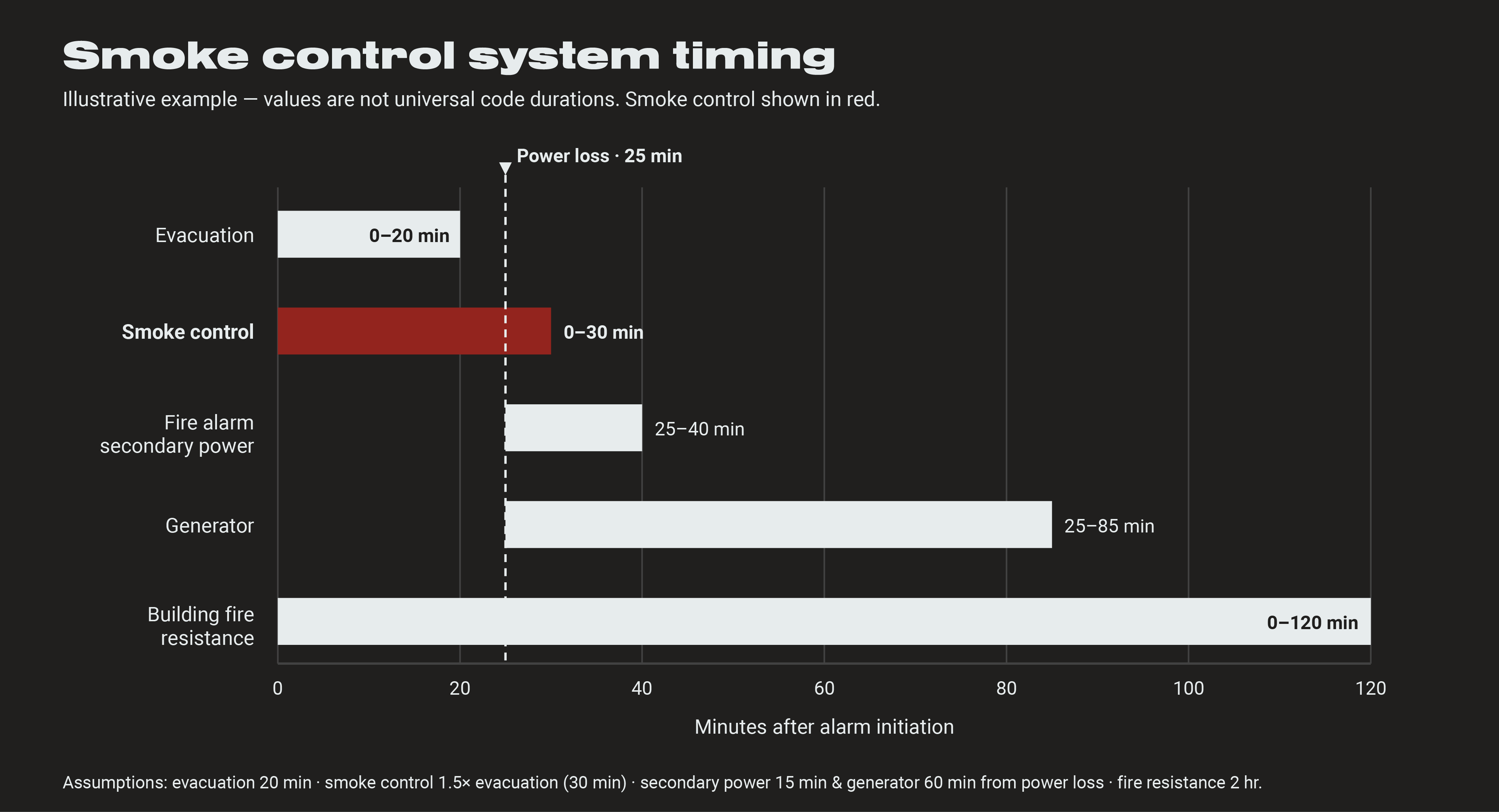
Now the critical engineering issue. Power availability and pathway survivability are different. A generator can provide electrical power, but it cannot ensure that an unprotected cable remains functional when exposed to fire. Likewise, a fire-rated circuit does not create a power source when utility power fails.
| Time after fire begins | Illustrative event |
|---|---|
| 0–20 minutes | Fire alarm and emergency functions operate; evacuation or relocation proceeds. |
| 20–25 minutes | Evacuation is assumed complete, yet emergency-response functions may still be required. |
| 25 minutes | Normal power is lost. The alternate sources and transfer equipment respond according to their design. |
| 25–40 minutes | The illustrative secondary-power interval runs for selected loads. Real battery capacity and connected loads set the true period. |
| 25–85 minutes | Generator support continues for designated loads. The 85-minute mark is a scenario endpoint, not a universal generator runtime. |
| 30 minutes onward | The illustrative smoke-control window has closed, yet the approved design and emergency operating strategy decide whether smoke control continues. |
| Through 120 minutes | The illustrative fire-resistance period continues. Each assembly performs according to its actual rating and exposure. |
Where the code requires it, critical wiring, enclosures, protected routes, and secondary power circuits must meet the applicable survivability provisions. IBC Section 909.20.6.1, for example, addresses protection of specified smokeproof-enclosure control and power wiring, while NFPA 72 Chapter 12 establishes pathway survivability levels where other provisions call for them.
DESIGN FOR THE ENTIRE EMERGENCY, NOT JUST THE FIRST FEW MINUTES
Life safety systems answer to different performance objectives. Fire alarm batteries support monitoring and alarm functions. Emergency lighting buys time for safe egress. Sprinklers depend on an adequate water supply. Smoke control follows its approved operating strategy. Generators feed designated loads according to their required classifications.
The lesson behind all of it: no single operating time applies to every life safety system. Coordinate backup power for life safety systems across power sources, transfer times, battery capacity, fuel availability, operating sequences, and wiring protection — because the gaps rarely show when you review each system on its own.
A coordinated design answers three questions for every required system: What must operate? How long must it operate? And what must remain intact for it to operate? Answer those three for each system, and the emergency has far fewer places left to surprise you.
FREQUENTLY ASKED QUESTIONS
Do all life safety systems need the same backup power?
No. Each system answers to its own performance objective. Fire alarm secondary power generally supports 24 hours of standby plus a short alarm period, emergency lighting runs for at least 90 minutes, smoke control follows IBC Section 909, and generators follow their NFPA 110 classification. There is no single number for the building.
How long must a fire alarm system run on backup power?
NFPA 72 generally requires a protected-premises fire alarm system’s secondary power to support 24 hours of standby followed by 5 minutes of alarm. Emergency voice/alarm communication systems generally require 24 hours of standby followed by 15 minutes of signaling at maximum load. Confirm the exceptions in your adopted edition.
What is the difference between backup power and pathway survivability?
Backup power keeps electricity flowing when utility power fails. Pathway survivability keeps the circuit itself intact when fire attacks the wiring. A generator cannot protect an unprotected cable from fire, and a fire-rated circuit cannot generate power — a complete design accounts for both.
Discover more from Space Age Electronics Life Safety Blog
Subscribe to get the latest posts sent to your email.